
You turn the key or press the start button and nothing happens. Or the engine cranks slowly and gives up. Or the dashboard lights up but the car just will not start. It is one of the most common reasons East Bay drivers call us, and the good news is that many of these calls do not end with a tow.
This guide explains how to read the signs your car is giving you, what you can safely check yourself, and how to tell whether you need a jump start, a new battery or a tow to a repair shop.
First: Make Sure You Are Safe
If your car will not start in your driveway or a parking lot, you have time to think. If it stalled in traffic or on a freeway, safety comes first:
- Turn on your hazard lights.
- If you are on a freeway, stay in the car with your seatbelt on and do not walk across traffic lanes.
- If your car is blocking a lane, anyone is hurt or you feel unsafe, call 911.
Our guide on what to do when your car breaks down on a Bay Area freeway covers this in more detail. Once you are safe, you can work out what is wrong.
Listen to What Your Car Is Telling You
The sound (or silence) your car makes when you try to start it is the most useful clue. Here are the most common patterns. These are general signs, not a diagnosis, and a mechanic should confirm the cause.
Nothing at all: no lights, no sound
If the dashboard stays dark and nothing happens, the battery may be completely flat, or a battery cable may be loose or badly corroded. A jump start often gets the car going if the battery is simply drained.
Rapid clicking
A fast clicking sound with dim or flickering dash lights usually points to a weak battery. There is enough power to make the starter relay click but not enough to turn the engine. This is the classic case for a jump start.
Slow, labored cranking
If the engine turns over slowly, like it is struggling, the battery is often weak or near the end of its life. It may start with a jump, but it may also leave you stuck again soon.
One single click, then nothing
A single click with bright dash lights can mean the battery is fine but the starter or its connection has a problem. A jump start usually will not help here, and the car may need to be towed to a shop.
Engine cranks normally but will not fire
If the engine spins at normal speed but never catches, the battery is probably not the issue. The problem could be fuel, ignition or a sensor. Check that you have not simply run out of gas. If the tank is empty, fuel delivery can get you moving. If not, a tow to a repair shop is usually the next step.
Simple Checks You Can Do Yourself
Before you call anyone, a few quick checks can save time:
- Automatic cars: make sure the shifter is fully in Park. Some cars will not start in Drive or if the shifter is not fully engaged. Try Neutral as well.
- Manual cars: press the clutch pedal all the way down.
- Push-button start: keep your foot firmly on the brake. If the key fob battery is weak, your owner’s manual will show how to start the car with the fob held close to the button or in a special slot.
- Steering lock: if the key will not turn, gently move the steering wheel left and right while turning the key.
- Lights left on: check whether headlights, interior lights or a charger were left on overnight. That points to a drained battery.
- Fuel gauge: confirm you have fuel, especially if the gauge has been unreliable.
Do not keep cranking the engine over and over. Long cranking can drain what is left of the battery and can overheat the starter. A few short tries is enough.
When a Jump Start Is Likely to Work
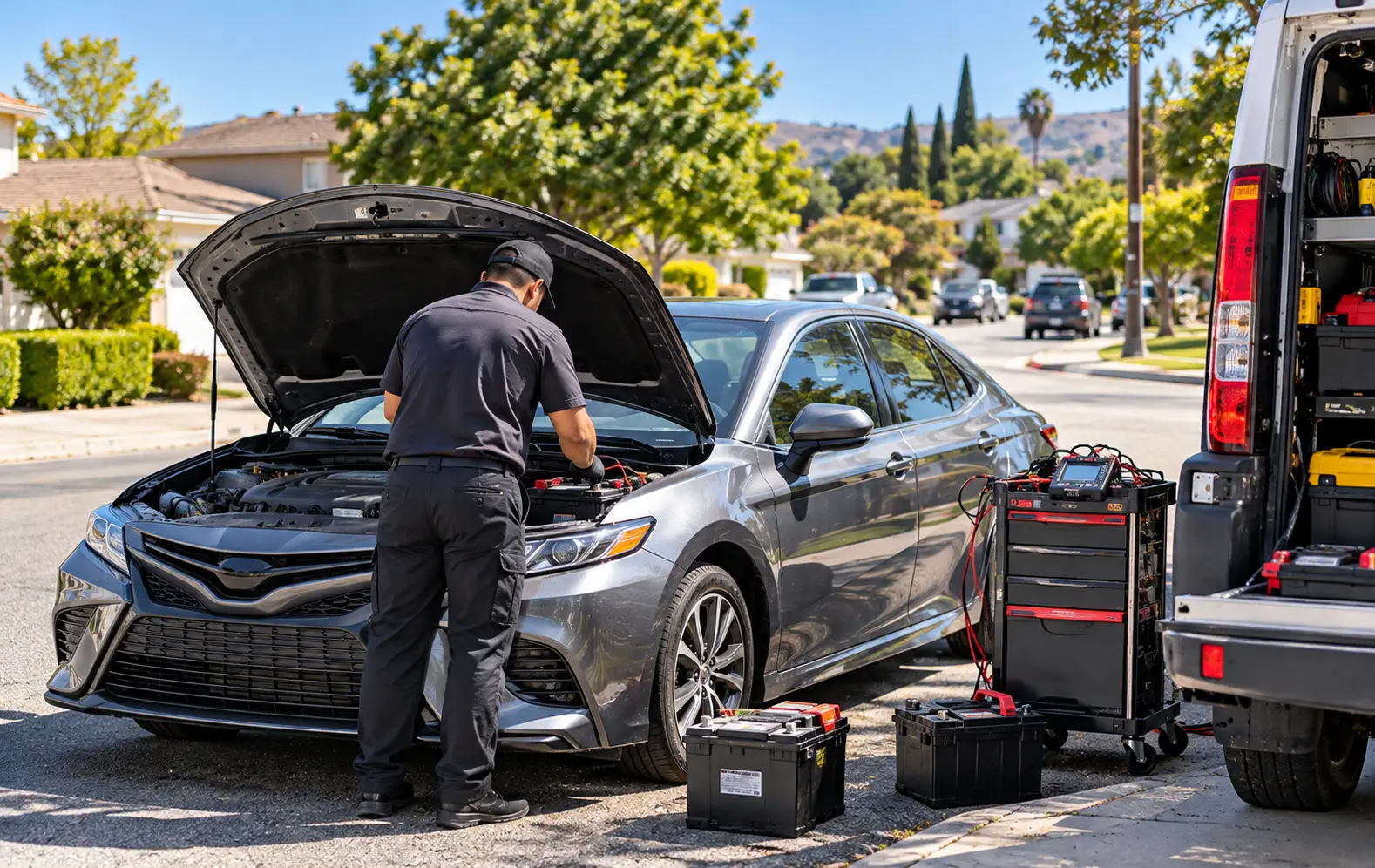
A jump start is a good first step when the signs point to a drained or weak battery: no power at all, rapid clicking, or slow cranking, especially after the car sat for a while or something was left on. A technician can connect a jump pack or cables safely and get the engine running in a few minutes.
After a successful jump, drive the car for a while so the charging system can top the battery back up, and have the battery and charging system tested soon. If the car will not restart later, the battery or the alternator may need attention.
When You Probably Need a New Battery
Car batteries wear out over time. Heat in places like Dublin, Pleasanton and Livermore is hard on batteries, and short trips that never fully recharge them do not help. Signs your battery may need replacing include:
- You have needed more than one jump start recently.
- The engine cranks slowly on most mornings.
- The battery case looks swollen, cracked or leaking, or the terminals are heavily corroded.
- The battery is several years old and has never been replaced.
If the battery is the problem, mobile car battery replacement can often be done where the car is parked, so you do not need a tow.
When You Need a Tow Instead
Some no-start problems cannot be fixed at the roadside. It is usually time for a tow to a repair shop when:
- The car still will not start after a jump start.
- You hear a single click or grinding noise from the starter.
- The engine cranks normally but will not fire, and you have fuel.
- The car starts after a jump but dies again while driving, which can point to a charging problem.
- There is smoke, a burning smell, a fuel smell or fluid leaking under the car. In that case, do not keep trying to start it.
- Warning lights for oil pressure or engine temperature came on before it stopped.
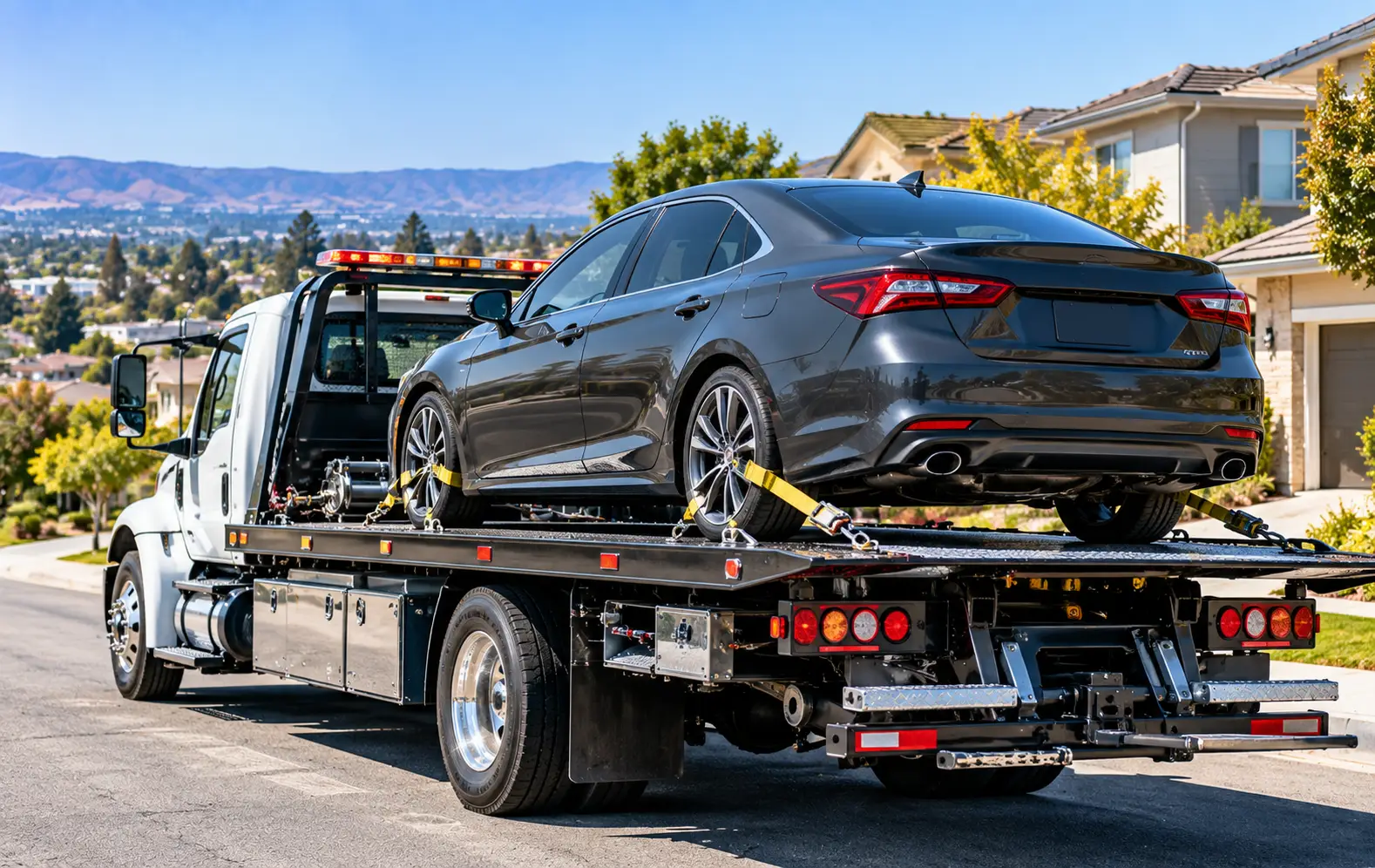
We can tow your car to your home, your regular mechanic or a dealership. If your car is electric, hybrid or all-wheel drive, tell us when you call so we can send a flatbed. Our general towing services page explains the options.
What to Tell the Dispatcher When You Call
A few details help us send the right help the first time:
- Where the car is: the address, parking lot, garage level or freeway and direction.
- What happens when you try to start it: silence, clicking, slow cranking or normal cranking.
- The make and model, and whether it is electric, hybrid or all-wheel drive.
- Whether you already tried a jump start.
- Where you want the car to go if it needs a tow.
If you are in the Tri-Valley, see our pages for towing in Dublin, Pleasanton and Livermore. Closer to the bay, we also cover Hayward and Oakland.
Car Won’t Start: Frequently Asked Questions
Why won’t my car start when the lights come on?
Dash lights need much less power than the starter motor, so a weak battery can still light up the dashboard but not crank the engine. Rapid clicking or slow cranking usually points to the battery. A single click with bright lights can point to the starter.
Can a jump start damage my car?
When it is done correctly, with the cables connected in the right order or a proper jump pack, a jump start is a routine job. Connecting cables the wrong way can damage electrical parts, which is why it is safest to have a trained technician do it if you are not sure.
How do I know if it is the battery or the alternator?
If the car starts with a jump and keeps running, then will not start again later, the battery may not be holding a charge. If the car dies while you are driving or the battery warning light comes on, the alternator or charging system may be the cause. A shop can test both.
Should I keep trying to start the car?
No. A few short tries is enough. Long or repeated cranking can drain the battery further and overheat the starter. If you smell fuel or burning, or see smoke, stop trying and call for help.
Do you come to me, or do I need a tow?
Both are possible. Jump starts, battery replacement, fuel delivery and lockout help happen where your car is parked. If the car still will not run, we can tow it to the shop you choose.
Car won’t start in the East Bay? Call A9 Towing Company 24/7 at (510) 200-9900 for a jump start, battery help or a tow.
This article is general information, not a mechanical diagnosis. If you smell fuel or see smoke, move away from the car and call 911.